
 Report of the Chairman of the Board of Directors and of the Director
 Human resources policy
 Risk management
 Governance
 Market Situation
 Strategic asset allocation for the three social security funds
 Asset classes >
  Performance
 Overview of the aggregate accounts


Activity report 2025
Report of the Chairman of the Board of Directors and of the Director
In 2025, compenswiss achieved an investment result of 6.34%. This positive performance came against the backdrop of a year marked by escalating geopolitical and trade tensions.
2025 was characterised by increasing geopolitical and trade tensions. The US’s protectionist tariff policy exacerbated international uncertainty. In this context, the global economy grew by around 3%, supported by a robust US economy and solid developments in several emerging markets. The eurozone, by contrast, lagged significantly behind. Despite persistent inflationary risks, the gradual decline in inflation rates enabled many central banks to adopt a more accommodative monetary policy by cutting key interest rates.
In a complex macroeconomic environment, stock markets demonstrated remarkable dynamism and stability. The year was characterised by a strong rebound in equity markets, particularly in the United States, where technology stocks were the main drivers of the S&P 500’s performance. The Swiss Performance Index (SPI) also delivered a solid performance, closing 2025 with a 17% rise. Gold once again confirmed its role as a safe-haven asset, recording historic gains. In the foreign exchange market, the US dollar weakened by nearly 13% against the Swiss franc.
6.34%
Positive investment return
Net returns of the individual social insurance schemes
The net return on assets at the end of 2025 was 6.34%, while the net return on cash reached 0.46%.
The net returns of the individual social insurance schemes amounted to 5.89% for the OASI, 5.92% for InvI and 6.03% for the LEC. The slight differences are due to the different levels of liquid assets held by the individual social security funds.
The total assets managed by compenswiss, including administrative assets, increased by CHF 4.63 billion to reach CHF 50.69 billion (previous year: CHF 46.06 billion). This increase resulted from a return of 6.34%, representing CHF 2.72 billion, as well as a net transfer of cash of CHF 1.91 billion between the Central Compensation Office and compenswiss. Approximately half of the assets are managed internally and the other half by external managers in Switzerland and abroad.
Pension payments were always guaranteed in 2025.
50.69 billion
Total assets managed by compenswiss
OASI: the question of funding the 13th pension remains unresolved
Following the adoption of the popular initiative for the introduction of a 13th OASI pension by the Swiss people and the cantons in March 2024, the Federal Council submitted a proposal to Parliament on the implementation and financing of the13th pension. Parliament has approved the payment arrangements, which will be made annually alongside the December pension, starting in December 2026. However, the question of funding the 13th OASI pension, the additional costs of which are estimated at between CHF 4 and 5 billion per year, remains under consideration in Parliament. To prepare for the first payment of the 13th OASI pension, compenswiss built up liquidity reserves of CHF 2 billion during 2025. These reserves will ensure the payment of the 13th pension at the end of 2026, without having to sell assets during 2026 to enable this payment.
According to the financial outlook from the Federal Social Insurance Office (FSIO) in August 2025, OASI expenditure will exceed revenue from 2026 onwards. Without additional measures to finance the 13th pension, the OASI Compensation Fund will fall below the statutory threshold of 100% of annual expenditure, which could jeopardise the Fund’s long-term stability.
"According to Art. 107(3) of the Old-Age and Survivors’ Insurance Act (LAVS), the OASI Compensation Fund must not, as a general rule, fall below the amount of annual expenditure."
InvI: deterioration in the financial situation
The FSIO’s financial outlook for August 2025 forecasts a continued deterioration in the situation of the InvI Compensation Fund. The main factor behind this trend is the steady increase in the number of new pensions. Added to this is the InvI’s debt to the OASI, which stands at CHF 10.3 billion and for which no repayment is currently foreseeable in the short term. Interest charges on the debt amounted to CHF 216 million in 2025, the same amount as in 2024. Against this backdrop, compenswiss plans to sell assets worth approximately CHF 35 million per month in 2026, in order to ensure the availability of the liquidity required to pay Invl pensions and benefits.
LEC: remarkable financial strength
The compensation fund of the Loss of earnings compensation scheme is in good health and remains, at this stage, shielded from the financial challenges facing the OASI and InvI funds.
Responsible investing
compenswiss pursues a clear ESG strategy based on four pillars: the integration of sustainability criteria into the investment process, the active exercise of voting rights for Swiss equities held in the portfolio, targeted shareholder engagement and binding exclusions. The portfolios are regularly assessed against ESG indicators and the Swiss Climate Scores to ensure transparency and climate compatibility. The exclusion lists include companies with controversial practices as well as activities in the thermal coal sector.
Activities of the Board of Directors and its Committees
In 2025, the compenswiss Board of Directors held four regular meetings, one special meeting and one workshop. As every year, it determined the annual asset allocation. It addressed the issue of the deteriorating financial outlook for the InvI and the financial implications of the introduction of the 13th OASI pension in 2026. Its work also focused on the development and adoption of the 2026–2029 corporate strategy. During its workshop, the Board of Directors addressed the issue of introducing a differentiated allocation by social insurance scheme and examined the statutory coverage ratio of the OASI and the InvI, as well as the InvI’s debt to the OASI. Finally, it raised legal questions concerning its liability in relation to liquidity.
The Investment Committee held four regular meetings and one special meeting. It focused on the annual asset allocation and defined the detailed allocation for 2026. Furthermore, the Committee analysed the effects of the 13th OASI pension on cash flow. It also examined the potential implications of the deterioration in the InvI’s financial outlook on the investment strategy, leading to a proposal for a differentiated allocation for the InvI in 2026.
In 2025, the Audit and Personnel Committee dealt with reports and issues relating to external and internal audit during four regular meetings. It examined regulatory aspects, in particular the revision of the staff regulations, as well as human resources matters. In addition, it contributed to the development of the 2026–2029 corporate strategy and devised a communication concept aimed at establishing a framework for measures and actions in this area. Finally, it continued its efforts to optimise and strengthen governance.

Photo: Patric Pop
Board ofDirectors
From left to right: Adrian Martinez (representative of the FFA), Bruno Parnisari (representative of the FSIO), Adrian Wüthrich, Ruth Meier, Cristina Maderni, Philippe Augsburger, Gabriela Medici, Manuel Leuthold, Elisabeth Bourqui, Michaela Troyanov, Verena Bernhard, Hans-Ulrich Bigler
Absent: Roland A. Müller
Operations and resources
At the end of 2025, compenswiss employed 62 members of staff, or 58 FTE (2024: 62 people or 57 FTE).
The ratio of operating costs to assets remains low at 0.09% (2024: 0.11%). Taking into account the costs included in the investment result (stamp duty, management fees for external funds, performance fees), this ratio rises to 0.17% for 2025 (2024: 0.18%). The annual budget was once again adhered to in the year under review.
0.09%
Operating expenses as a percentage of assets
On 29 June 2022, the Federal Council adopted the new accounting standards applicable to compenswiss. These standards are essentially based on IPSAS (International Public Sector Accounting Standards). The entry into force of these new standards on 1st January 2025 led to changes in accounting principles. These changes had an impact on insurance capital but only a marginal effect on assets under management.
The work launched in 2024 on the new portfolio management system was successfully completed in autumn 2025. This migration to a new platform has enabled processes to be harmonised and complexity to be reduced. Many staff members were involved in the implementation of this strategic project and contributed to the smooth running of the migration.
Another strategic project focusing on information management was continued in 2025. This project, which will be finalised in the course of 2026, will enable compenswiss to adapt to good governance requirements. The completed projects and those still in progress strengthen compenswiss’s efficiency and resilience and prepare the organisation for future challenges.
In 2025, a new information security awareness campaign featuring several interactive training modules was carried out within the Management Office. In addition, four conferences on the theme of «Professionalism» featuring external speakers, as well as an inspirational talk on resilience led by sailor Justine Mettraux, were organised for all staff members with the aim of strengthening the corporate culture and promoting compenswiss’s values in day-to-day work.
Discussions surrounding the 13th OASI pension and issues relating to the new custodian bank continued to attract increased interest from the media, politicians and the general public during the year under review. compenswiss responded to enquiries from journalists, politicians and the public with comprehensive and transparent communication. compenswiss is committed to providing sound, factual and objective information about its activities in managing the assets entrusted to it. A wealth of information is also available on the website www.compenswiss.ch.
"Completed and ongoing projects strengthen compenswiss’s efficiency and resilience and prepare the institution for the challenges of tomorrow."
Changes and acknowledgements
Ms Verena Bernhard, a member of the Board of Directors since 2024, stepped down from the Board of Directors and the Audit and Personnel Committee on 31 December 2025. We would like to thank her warmly for her valuable contribution. Mr Adrian Martinez, Deputy Director of the Federal Finance Administration (FFA), replaced Mr Urs Eggenberger as the FFA’s representative on the compenswiss Board of Directors and the Investment Committee with effect from 1 January 2025. We welcome Mr Martinez.
We would like to thank the members of the Board of Directors and all staff for their unwavering commitment and dedication over the past financial year.
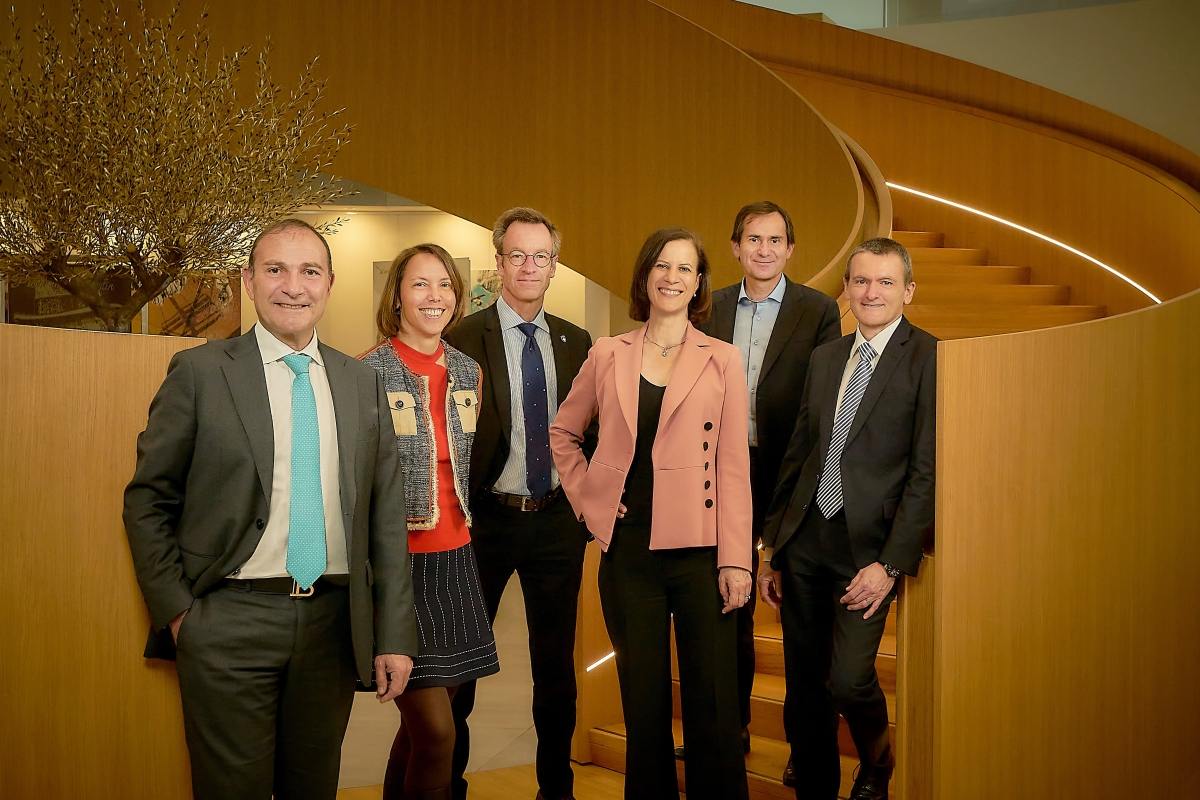
Photo: Patric Pop
Executive Committee
From left to right: Frank Juliano, Gaëlle Barlet, Eric Breval, Francesca Azzi Price, Vivien Ravel, Marc Pfenninger